How AI Is Reshaping Skills in Life Sciences Manufacturing


Artificial intelligence is changing the skills required to operate, improve and scale manufacturing environments. In life sciences, manufacturers must compete for scarce technical talent that understands both advanced technology and highly regulated production environments.
AI technologies have the potential to revolutionize how work gets done in the life sciences industry — but the challenge now is finding the right skills to support these advances. In this blog, I discuss the risks and rewards of AI, and the strategies leading organizations are using to gain competitive advantage in this exciting era.
What Are Some Use Cases for AI?
We’re seeing AI technologies being rolled out across the entire pharmaceutical and medical device manufacturing landscape. Collectively known as life sciences, this industry has identified some common use cases:
- Process design
- Process monitoring
- Advanced process controls
- Trend monitoring
These are not peripheral use cases. They sit directly in the systems that determine batch success, product quality, capacity utilization and patient supply.
For many organizations, the challenge is not deciding whether to implement AI. The challenge is finding and keeping the skilled people who can work alongside it.
The Risks and Rewards for AI in Life Sciences Manufacturing
Manufacturing leaders are understandably attracted to AI because it can help address persistent pain points: unplanned downtime, batch variability, manual review burden, slow investigations, yield loss, and fragmented shop-floor data.
McKinsey estimates that
AI could create $4 billion to $7 billion annually in value for biopharma operations.
These savings would be achieved through productivity gains, workload and cost reductions, quality improvements, and better equipment effectiveness.
However, life sciences manufacturing is not a typical industrial environment. In good manufacturing practice (GMP) operations, AI cannot simply be deployed because it is faster or more efficient. It must be explainable enough, validated appropriately, governed throughout its life cycle, and embedded within the pharmaceutical quality system.
In other words, human oversight is essential for success.
Why Is Talent Becoming the Biggest AI Challenge?
The life sciences industry already faces significant talent shortages; while at the same time, AI is creating demand for new capabilities that many organizations struggle to find.
According to ManpowerGroup's 2026 Healthcare & Life Sciences World of Work Outlook,
77% of healthcare and life sciences employers report difficulty finding the skilled talent they need.
As AI adoption accelerates, manufacturers aren't simply looking for more employees; they're looking for employees with a different mix of skills.
Manufacturers still need process engineers, validation specialists, automation engineers, quality professionals, maintenance technicians, and production leaders. However, many of these roles now require:
- AI literacy
- Data analysis skills
- Digital problem-solving capabilities
- Experience with automated systems
- Cross-functional collaboration
- Regulatory and quality expertise
The result is a new talent equation: manufacturers must compete for technical talent that understands both advanced technology and highly regulated production environments.
What Skills Are Becoming Most Valuable in the Life Sciences Industry?
AI is increasing demand for hybrid talent — people who can combine manufacturing expertise with digital capabilities.
This hasn’t yet affected production worker jobs. Our clients aren’t seeking new skills for these positions — rather, they’re training new hires on AI-powered equipment and processes.
However, there are changing requirements for other roles. Here are a few examples.
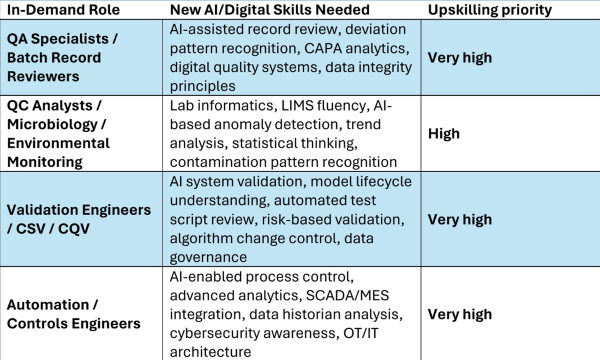
Here’s a look at some of the most sought-after skills across the industry:
- Data and Digital Literacy
- Automation and Systems Knowledge
- Quality and Regulatory Expertise
- Critical Thinking and Decision-Making
- Adaptability
Why Won't AI Eliminate the Manufacturing Talent Shortage?
AI can improve productivity, but it can’t replace the expertise required to operate regulated manufacturing environments.
As I mentioned earlier, life sciences manufacturing remains highly dependent on human judgment. AI may identify a quality deviation, but quality teams must still evaluate risk and determine corrective actions. AI may recommend maintenance activities, but engineers and operations teams must decide how and when to act.
This "human-in-the-loop" model will remain critical for compliance, validation, and quality assurance.
As a result, manufacturers should not expect AI to reduce their need for skilled talent. Instead, AI is increasing the value of employees who can effectively use technology while maintaining quality and regulatory standards.
How Can Life Sciences Manufacturers Find AI-Ready Talent?
The organizations gaining a competitive advantage are broadening their talent strategies rather than searching for perfect candidates.
Our advice?
-
Hire for learnability, not just experience
Many employers focus heavily on specific AI experience. However, candidates with strong manufacturing, engineering, quality, or automation backgrounds can often develop AI capabilities through targeted training.
Prioritizing curiosity, adaptability and continuous learning can significantly expand the available talent pool.
-
Expand recruiting beyond traditional sources.
Companies can find valuable talent by recruiting from:
- Advanced manufacturing sectors
- Industrial automation environments
- Process industries
- Semiconductor manufacturing
- Aerospace and defense manufacturing
Many professionals in these industries already possess transferable skills related to quality systems, automation, data analysis, and regulated operations.
-
Partner with workforce experts.
Specialized workforce partners can help organizations identify candidates with adjacent skills who may not appear through traditional recruiting channels.
This approach is particularly valuable for difficult-to-fill technical and manufacturing positions.
Retaining High-Demand Manufacturing Talent
Finding skilled workers is only half the challenge. Retaining them is equally important.
Employees with AI, automation, and advanced manufacturing skills are in high demand across industries. Organizations that fail to invest in workforce development risk losing talent to competitors.
Leading manufacturers are focusing on several retention strategies.
-
Invest in Continuous Learning.
Employees want opportunities to develop new skills. Providing access to AI training, digital manufacturing programs, automation certifications, and leadership development can increase engagement while building critical capabilities. For many workers, access to career development opportunities is a key factor in deciding whether to stay with their employer.
-
Create Clear Career Pathways.
Workers are more likely to stay when they understand how their roles can evolve. Showing employees how they can advance into areas such as automation, digital manufacturing, quality leadership, or data-driven operations can improve retention.
-
Involve Employees in Transformation Efforts.
Employees are more likely to embrace new technologies when leaders explain how AI will augment their work rather than replace it. As we explored in our article "How Should Leaders Implement AI and Automation?," organizations can increase engagement — and ultimate success — by prioritizing communication and change management.
-
Maintain a Human-Centered Culture.
Even as manufacturers invest in advanced technologies, employees continue to value communication, collaboration, flexibility and strong leadership. Human skills remain essential differentiators — and organizations that support them are often better positioned to retain talent.
What Should Leaders Do Next?
Talent attraction and retention efforts will only work if strategies are clear and leadership is actively involved.
According to an IBM study:
83% of CEOs say AI success depends more on people’s adoption and behavior change than on the technology itself.
AI adoption strategies should address:
- Future skill requirements
- Current workforce capabilities
- AI literacy and digital training
- Recruiting for adaptability and learning potential
- Strong governance structures
The most successful leaders view and treat workforce planning as a critical component of their AI strategy rather than a separate initiative.
Key Takeaway
AI is transforming life sciences manufacturing, but technology alone will not create a competitive advantage. The real differentiator will be talent.
Organizations that can attract, develop and retain professionals with a blend of manufacturing expertise, digital fluency, quality knowledge and critical thinking skills will be best positioned to succeed.
As AI becomes more deeply embedded in manufacturing operations, the question is no longer whether organizations will need these skills. The question is whether they can build a workforce ready to use them.
Manpower can help you assess emerging skill needs and build workforce strategies that prepare your organization for what comes next.