

Four Reasons Companies Are Investing in Industrial Automation


According to our Q3 2025 employment outlook survey of 40,000 employers worldwide, 61% of companies across industries report increasing their automation investments in 2025. Communication Services and IT report the highest increases at 70–71%. For a breakdown of automation by industry, geography and company size, see our white paper on global automation trends.
Industrial Automation and Automation Software: How to Define Automation
There are two broad categories of automation in the modern workplace.
Industrial Automation: Uses physical robots to handle manual tasks in manufacturing and other production environments.
Automation Software: Digital tools that improve employee productivity and efficiency by delegating simple tasks to smart machine partners.
So, what does automation really look like in today’s workplace — and why are so many companies betting big on it? Let’s break it down with real-world examples, benefits and a few challenges to keep in mind.
Types of Automation in Practice
Here are a few examples of each type of automation.
Industrial Automation
- Automated Welding Robots
Used in automotive manufacturing, these robots perform precise welds on car frames, increasing speed and consistency while reducing human exposure to hazardous environments. - Pick-and-Place Robots
Common in electronics and packaging industries, these robots quickly move items from one location to another — like placing circuit boards onto conveyor belts or sorting packaged goods. - Collaborative Robots (Cobots)
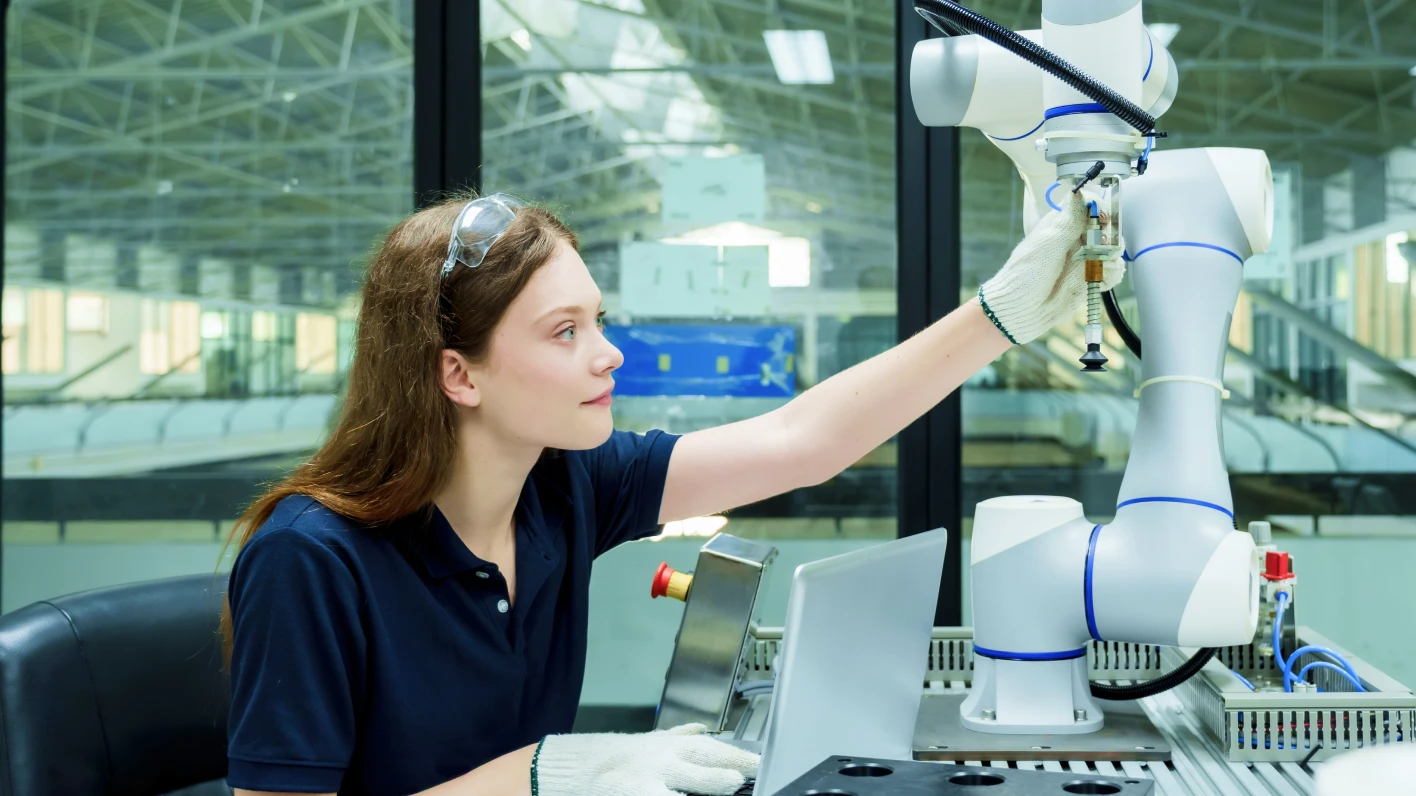
These are designed to work safely alongside humans, assisting with tasks like assembly, material handling or even quality inspection in small-batch production environments. For more on cobots, see our blog, Putting Industrial Robots on the Payroll. - Automated Guided Vehicles (AGVs)
Used in warehouses and factories to transport materials across facilities without human drivers, improving logistics and reducing manual labor.
Automation Software
- Robotic Process Automation (RPA)
Software bots that handle repetitive digital tasks like data entry, invoice processing or employee onboarding — often used in HR, finance and customer service. - AI-Powered Chatbots
These virtual assistants help customers with common inquiries, freeing up human agents for more complex issues. They’re widely used in retail, banking and telecom. - Automated Scheduling Tools
Platforms like Calendly or Microsoft Bookings automatically coordinate meetings, send reminders and manage calendars — saving time for teams and clients. - Document Generation and Approval Workflows
Tools like DocuSign or Adobe Acrobat automate the creation, routing and signing of contracts and forms, speeding up legal and procurement processes.
4 Reasons Businesses Are Investing in Automation
Automation is no longer a futuristic concept — it’s a strategic imperative. Companies are turning to automation for several key reasons:
1. Productivity Gains.
Automated systems complete tasks faster and with fewer errors, freeing up human workers for higher-value activities. A McKinsey report estimates that automation could raise productivity growth on a global basis by as much as 0.8 to 1.4 percent annually. And this is despite the fact that the workforce is shrinking due to demographic shifts.
2. Cost Reduction.
By streamlining operations and reducing reliance on manual labor, businesses can significantly cut costs over the long run. This doesn’t mean replacing humans with machines, but replacing some of their duties with higher-value tasks.
3. Scalability.
Automation allows companies to grow without proportionally increasing headcount or overhead. This significantly enhances agility and is especially important during talent shortages.
4. Competitive Advantage.
Early adopters of automation technologies can outperform competitors in all of the above: productivity, scalability and cost reduction — not to mention innovation.
Accelerating Innovation: Process Automation and Smart Manufacturing
Here are some examples of how industrial and software automation complement each other:
End-to-End Process Optimization
Industrial automation handles the physical side — like assembling products or packaging while software automation manages the digital workflows — like inventory tracking, quality control reporting or scheduling maintenance.
Together, they create a seamless system where machines do the heavy lifting and software keeps everything running smoothly behind the scenes.
Smart Manufacturing
In modern factories, truly smart manufacturing combines robots to build a product while software automation monitors performance, predicts maintenance needs and even adjusts production schedules in real time.
Enhanced Decision-Making
Data collected from industrial machines can be analyzed by software automation tools to improve efficiency, reduce downtime and inform strategic decisions.
How to Design Automation for Success
Before embarking on your next automation investment, be sure to keep these best practices in mind:
- Assess your needs. Using sufficient, reliable data, identify tasks and processes that are repetitive, time-consuming or error-prone.
- Design human-friendly systems. Keep in mind that humans are both users and consumers of these technologies. Leaders must work with their development partners and vendors to create intuitive and easy-to-navigate user interfaces that decrease adoption time and frustration and simplify training and onboarding processes.
- Consider end-to-end integration. Neither industrial nor software automation can drive efficiency and other business outcomes if new technologies are not seamlessly integrated with other IT systems and existing human-driven processes. Ideally, human workers will leverage these tools and others within one platform, and centralized data management and storage will provide a single source of the truth.
- Create an infrastructure for human/machine team assembly. Nearly all work teams of the near future will require human and smart machine collaboration, and job roles must be configured as such. It’s critical to redesign your roles so that you break the work down into its component parts and assign tasks and workflow based on the relative strengths and skills of the technology and human experts. It’s also important to redesign your management and communications strategy to support a new way of working.
- Facilitate supervised independence. Leaders tend to overestimate smart machines’ capabilities – especially when the technology is billed as “autonomous”. Even as the most sophisticated offering to date – agentic AI – becomes more capable, it still requires extensive human oversight. Human experts need to allow automation to work its magic while also monitoring and judging its effectiveness at every step. Your human employees on the front lines should also be prompted to speak up regarding the most practical ways to work alongside industrial and software automation.
- Measure success beyond raw productivity. It will take some time to realize an increase in productivity as new automation is rolled out and process optimization is worked out. In the beginning, it’s better to collect metrics on error reduction, employee satisfaction and engagement.
Challenges and Considerations
While automation offers many benefits, it also presents challenges:
- Initial Costs: Upfront investment in technology and training can be significant.
- Workforce Impact: Automation may shift job roles, requiring reskilling and thoughtful workforce planning.
- Cybersecurity Risks: Automated systems must be protected from digital threats.
- Ethical Concerns: Businesses must ensure transparency and fairness in AI-driven decisions.
Looking Ahead
Automation isn’t just changing how we work — it’s changing how we think about work. While the technology will continue to evolve in ways we can’t fully predict, one thing is clear: it’s not just about replacing tasks, it’s about reimagining workflows, unlocking new efficiencies and empowering people to focus on what matters most.
With 61% of global companies ramping up their automation investments, the message is loud and clear — the future of work is being built right now. Whether it’s industrial robotics, intelligent software, or a smart blend of both, businesses are finding new ways to work smarter, faster and more effectively.
Curious about what automation could look like in your organization? Let’s start the conversation.