Why Industrial Employers Are Moving to Skills-Based Hiring


Industrial employers are moving to skills-based hiring because talent shortages, automation and rapidly changing job requirements are making traditional credentials less reliable indicators of success.
The Future of Manufacturing Hiring Starts Here
Hear how manufacturing leaders are expanding talent pools, strengthening workforce strategies and preparing for evolving workforce demands. Join our October 20 webinar.
For years, industrial employers have faced a growing challenge: cutting-edge technologies are transforming operations, workers with traditional skills are being displaced, and workers with tech skills are in short supply.
In this blog, I discuss this skills gap and how it’s prompting employers to move to skills-based hiring, with the key question switching from, "Where did someone learn?" to "Can they do the work?"
Why Are Industrial Employers Reevaluating Degree Requirements?
Industrial employers are reevaluating degree requirements because talent shortages and rapid technological change are exposing the limitations of traditional hiring models.
What I’m seeing in the field is underscored by our recent research:
75% of U.S. manufacturing employers report difficulty finding skilled talent — the highest among all sectors surveyed
And as the economy expands, the shortage will intensify. According to the Manufacturing Institute,
Manufacturers will need up to 3.8M new employees by 2033.
Behind the Talent Shortages
Aging workforce
Here’s a preview of the coming storm:
26% of the industrial workforce is expected to retire by 2030
Shortages are expected to be particularly acute in skills-intensive occupations such as CNC machining, maintenance, and process engineering.
Demographic changes
The U.S. birth rate has been declining for years, meaning that the overall workforce is shrinking.
As of June, 2026, the national labor participation rate dropped to 61.5%, the lowest level in five decades
Young people are looking elsewhere
Industrials is suffering from an image problem. A study of 2,000 Gen Zers by the workplace safety technology company Soter Analytics found that
Only 14% of Gen Zers would consider industrial work as a career
Some of the reasons given included low pay, limited benefits and safety concerns.
Educational institutions are lagging behind
While most young people are conversant with Gen AI tools, they’re not gaining their knowledge in the classroom. In one study, conducted among students from various programs at multiple universities:
Only 3% of students felt very confident that their education would help them secure a job in a field involving AI.
Overcoming these obstacles won’t happen without taking a new approach to hiring and workforce management.
What Is Skills-Based Hiring?
Skills-based hiring helps employers identify qualified candidates who may be overlooked by traditional degree-focused recruiting practices.
Organizations that prioritize capabilities over credentials can access new sources of talent, including:
- Skilled trades professionals
- Veterans transitioning to civilian careers
- Community college graduates
- Apprenticeship graduates
- Workforce re-entry candidates
- Workers moving from adjacent industries
This approach is particularly valuable in manufacturing, logistics and supply chain environments where job vacancies can directly impact productivity and growth.
I want to emphasize that skills-based hiring does not mean lowering standards. Instead, it means aligning hiring criteria more closely with actual job requirements. Employers can focus on demonstrated competencies, practical experience and learning potential rather than relying on degrees as a proxy for capability.
The result is often a larger talent pool, improved recruiting efficiency and stronger alignment between business needs and workforce capabilities.
What Skills Matter Most in Today's Industrial Workforce?
Employers are increasingly prioritizing demonstrated skills, adaptability and practical experience over educational pedigree alone.
The most valuable employees often combine technical expertise with the ability to learn new processes and technologies as business needs evolve.
Technical skills
- AI proficiency
- Equipment operation
- Mechanical troubleshooting
- Automation systems
- Quality management
- Robotics
- Industrial software and digital tools
- Safety and compliance
Human skills
- Communication
- Teamwork
- Problem solving
- Adaptability
- Continuous learning
- Critical thinking
How Can Manufacturing Employers Successfully Shift to Skills-Based Hiring?
Moving to skills-based hiring requires more than changing job descriptions — it requires leaders to rethink how talent is identified, developed and deployed across the organization.
For many industrial and manufacturing employers, skills-based hiring represents a significant cultural shift. Managers who have traditionally relied on degrees, years of experience or specific career paths may need new tools and frameworks to evaluate talent based on capabilities and potential.
Leadership buy-in is essential to ensure hiring, workforce planning and employee development strategies align around a common definition of the skills needed for future success.
Lead the change
Successful skills-based hiring initiatives start with strong change management. Leaders should clearly communicate why the organization is shifting its approach, how skills-based hiring supports business goals, and what the change means for employees and managers. Transparency helps build confidence while reducing concerns that new technologies, automation or AI are replacing workers rather than creating opportunities for growth.
Organizations should also equip hiring managers with the training, assessment tools and decision-making frameworks needed to evaluate candidates based on demonstrated capabilities rather than credentials alone.
Create visible career pathways
Skills-based organizations help employees understand how they can grow within the business. By mapping skills to future roles, employers can create clear paths from entry-level positions to technical, leadership or specialized careers. This not only supports retention but also encourages employees to continuously develop the capabilities the organization will need in the future.
The Buy-Borrow-Build Talent Strategy
As skill requirements evolve, employers should take a comprehensive approach to workforce planning by determining which capabilities can be built internally, which should be hired externally and which can be accessed through flexible talent models.
This approach helps organizations respond more quickly to changing business demands while reducing reliance on any single talent source.
Employers buy talent with specialized skills that are not currently available within the organization, borrow temporary or contract talent when immediate expertise is needed, and build internal talent through upskilling.
For more on build-buy-borrow model in engineering, see Build vs Buy: Defining Your Engineering Workforce Strategy
Prioritizing internal talent development
Of the three workforce planning approaches, the greatest long-term opportunity often comes from building talent internally.
When employers invest in upskilling and reskilling, they aren't simply filling immediate skills gaps. They're creating a workforce that can adapt alongside evolving technologies while improving employee engagement, retention and career satisfaction.
Research from Right Management's 2025 State of Careers report found that employees increasingly expect growth opportunities and are more likely to remain engaged when they can see a clear future within the organization.
Industrial employers can strengthen retention and workforce readiness by:
- Creating visible career pathways
- Encouraging cross-functional movement
- Rewarding skill development
- Investing in technical and digital skills training
- Offering leadership development and industry certifications
Employees are more likely to stay when they understand how their current skills connect to future opportunities.
Here’s an example:
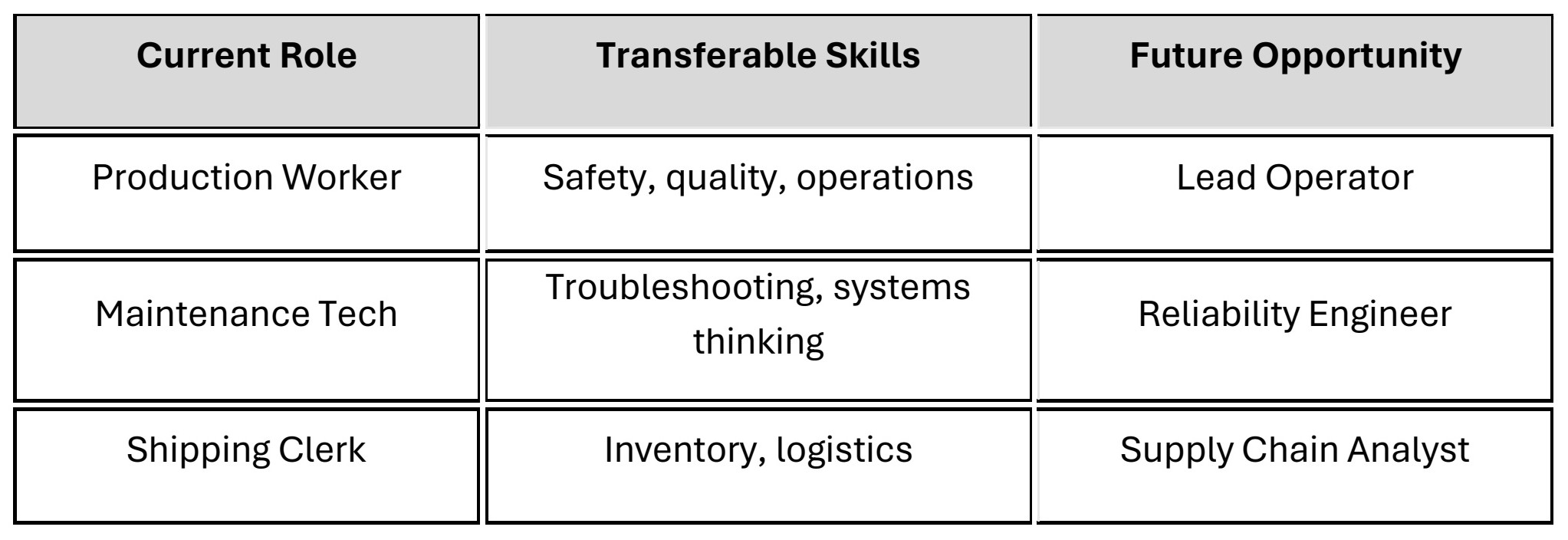
These pathways create opportunities for workers who may not have followed conventional educational routes. They also help employers develop talent from within rather than relying exclusively on external hiring.
The importance of evolving pathways
Just as your car’s GPS updates based on current traffic conditions, it’s important that your talent development strategy is updated regularly to stay current with ever-advancing technology. What looked like the next logical step in a worker’s career yesterday may not be the case today—and certainly won’t be true tomorrow.
In the face of ever-advancing technology, flexibility is key.
The Takeaway
Skills-based hiring succeeds when organizations look beyond credentials to identify talent with the skills, adaptability and learning agility needed for today's industrial workforce.
Industrial employers can no longer rely on traditional talent pipelines alone. Talent shortages, retirements, technological change and evolving workforce expectations are forcing organizations to rethink how they attract and develop talent. By expanding talent pools, investing in workforce development and creating clear pathways for advancement, employers can build the capabilities needed to compete in the years ahead.
The organizations that succeed will be those that recognize talent for what people can contribute today — and what they can grow into tomorrow.